
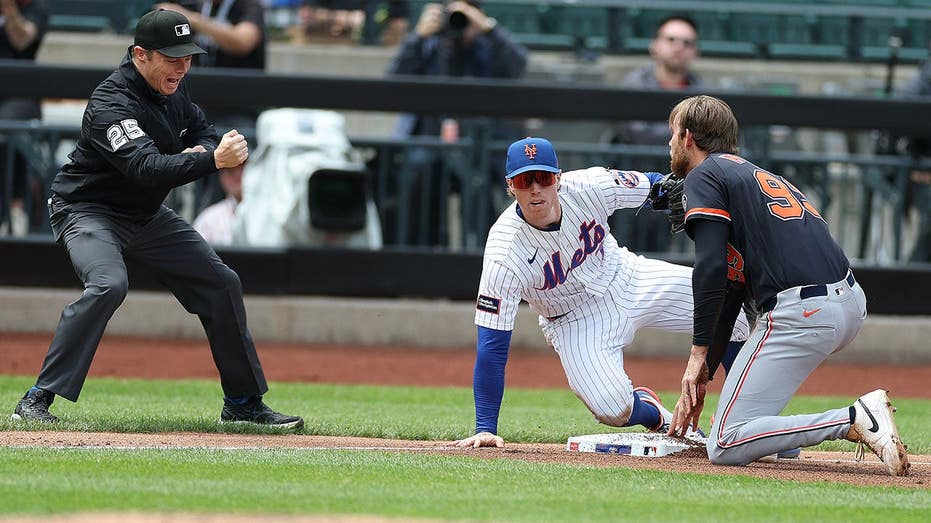
Detroit, MI – The roar from the Motor City wasn't just for the Tigers on Thursday; it was a collective bellow of frustration aimed squarely at Major League Baseball's replay review system. In a scene that quickly went viral across sports networks and social media, veteran play-by-play announcer Jason Benetti and analyst Andy Dirks, calling the game for the Detroit Tigers, unleashed a blistering critique of MLB's replay office after two pivotal calls were overturned in rapid succession, both favoring the visiting New York Mets in their 9-4 sweep-clinching win.
Benetti, known for his sharp wit and insightful commentary, didn't mince words, declaring, "This is gonna get ugly in a hurry." Dirks, a former MLB outfielder, echoed the sentiment, expressing visible disbelief and anger at the decisions emanating from the league's replay headquarters in New York. Their unvarnished takes resonated deeply with fans, igniting a fresh debate across American sports media about the efficacy, fairness, and potential biases inherent in a system designed to ensure accuracy but often seems to breed more controversy.
The Calls That Sparked the Firestorm
The particular incidents that drew the ire of the Tigers' broadcast team involved two plays that initially went Detroit's way on the field. The first, a close play at first base, was initially ruled an out, seemingly preserving a crucial moment for the home team. However, upon review, the call was overturned, giving the Mets a baserunner. Moments later, another controversial play, this time involving a potential double play, again saw the initial on-field ruling reversed after a replay challenge. These back-to-back reversals not only shifted the momentum definitively towards the Mets but also pushed Benetti and Dirks to their breaking point.
The announcers' frustration wasn't just about the outcomes of the specific plays; it was about the perceived inconsistency and the opaque nature of the review process. Benetti's declaration about things getting "ugly" quickly became a rallying cry for fans and analysts who have long expressed skepticism about MLB's replay system. For many, the visual evidence presented on broadcasts often appears inconclusive, yet the centralized replay office in New York frequently delivers definitive rulings that puzzle even seasoned baseball observers.
Replay's Troubled History in American Sports
Replay review, introduced to Major League Baseball in its current form in 2014, was initially heralded as a technological advancement that would eliminate egregious errors and ensure justice on the field. However, its implementation has been far from smooth. From the outset, there have been concerns about the speed of reviews, the criteria for overturning calls, and the subjective interpretation of often grainy or zoomed-in video evidence. Similar debates have raged in other major American sports, including the NFL, NBA, and NHL, each grappling with how to balance the quest for perfection with the flow and human element of the game.
For baseball, a sport steeped in tradition and nuance, the intrusion of technology has often felt disruptive. Fans, players, and broadcasters alike have voiced concerns that the endless pauses for review disrupt the rhythm of the game, extend its length, and at times, seem to contradict the very spirit of competition. The centralizing of replay decisions in a single remote location, far removed from the immediate context and atmosphere of the live game, has also fueled suspicions of bias or a disconnect from the realities on the field.
Implications for the American Pastime
The recent outburst from the Tigers' broadcast booth serves as a powerful reminder of the deep-seated anxieties surrounding replay in modern baseball. For American fans, the integrity of the game is paramount. When calls are overturned in a manner that seems arbitrary or inexplicable, it erodes trust and diminishes the enjoyment of watching a game that relies heavily on split-second decisions and human performance.
Expert analysts often point to the difficulty of creating a perfectly objective system for reviewing inherently subjective human actions. "Baseball is a game of angles and milliseconds," says Dr. Sarah Jenkins, a sports sociologist at Midwestern University. "What looks clear from one camera angle might be obscured or misleading from another. The challenge for MLB is to define 'clear and convincing evidence' in a way that is consistently applied and easily understood by the public, something they haven't quite mastered."
The broader implication for MLB, and indeed for all professional sports in the U.S., is the delicate balance between technological precision and the human element. Fans come to games for the drama, the athleticism, and yes, even the occasional controversial call that becomes part of baseball lore. When replay overshadows the game itself, or when its results consistently leave a sour taste, it threatens to alienate the very audience the league seeks to engage.
Looking Ahead: A Call for Clarity and Consistency
The passionate critique from Benetti and Dirks is unlikely to be the last. As the MLB season progresses, every controversial replay decision will undoubtedly be scrutinized, amplified by social media and discussed on sports radio and television across the nation. For Major League Baseball, this episode should serve as a wake-up call. The league faces increasing pressure to re-evaluate its replay protocols, potentially seeking greater transparency in decision-making, exploring alternative review models, or at the very least, providing clearer explanations for overturned calls.
The goal should be to create a system that enhances accuracy without detracting from the inherent drama and flow of the game. Until then, American baseball fans, players, and broadcasters will continue to watch with a critical eye, hoping that the technology designed to improve the game doesn't instead become its most frustrating antagonist.

💬 Comments (0)
No comments yet. Be the first to share your thoughts!
Leave a Comment