
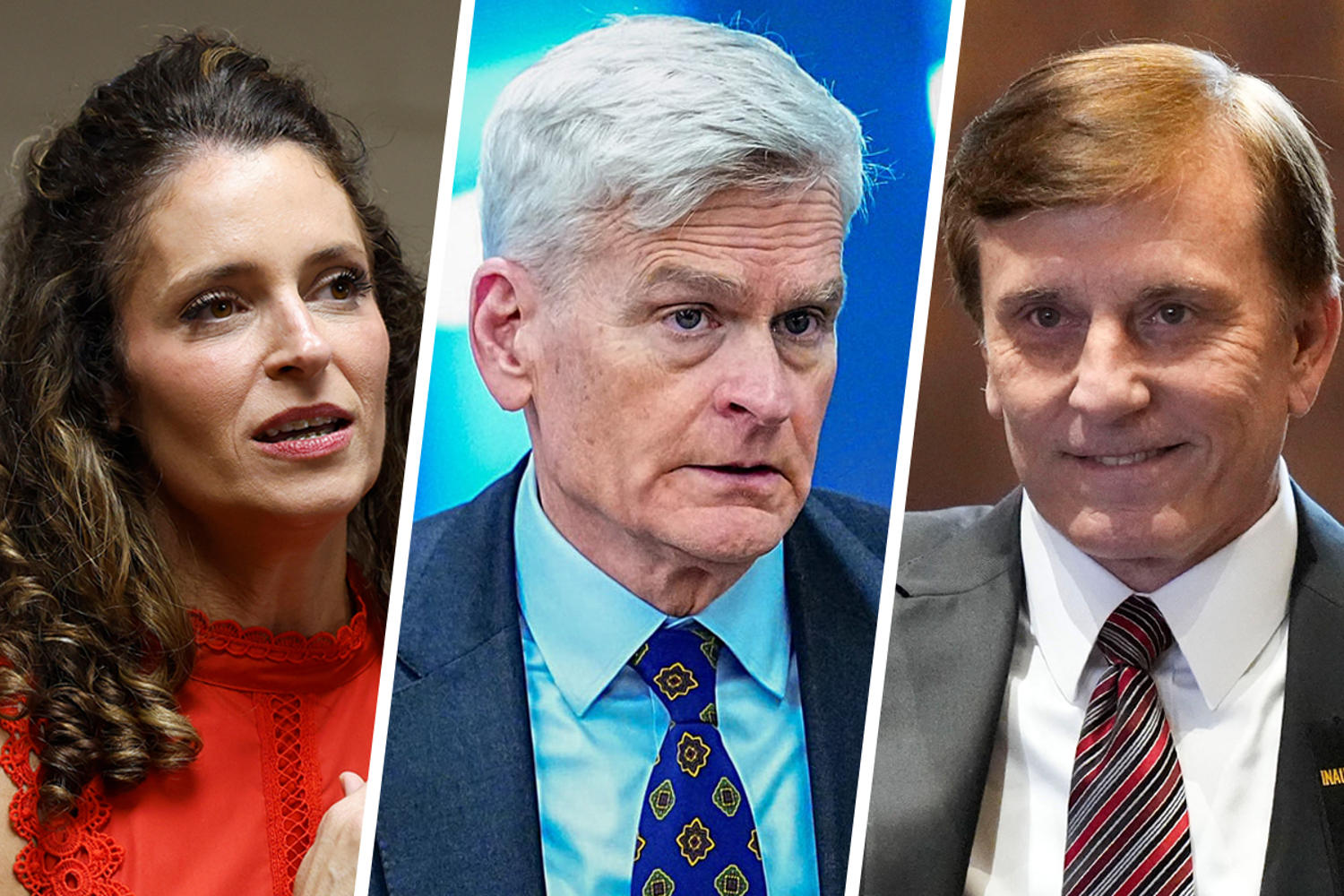
Shreveport, LA – The political fate of Louisiana Senator Bill Cassidy hangs precariously in the balance this Saturday as voters head to the polls, marking his first electoral test since his controversial vote to convict then-President Donald Trump in his 2021 impeachment trial. This isn't just another primary; it's a stark referendum on the enduring power of Trumpism within the Republican Party and a high-stakes battle that could redefine the GOP's landscape in the Bayou State.
Cassidy, a two-term incumbent, finds himself in an unfamiliar and precarious position, fending off formidable challenges from two prominent figures: Representative Julia Letlow, who boasts the coveted endorsement of former President Trump, and State Treasurer John Fleming. Both rivals have strategically positioned themselves as stauncher allies of the former president, effectively painting Cassidy as out of step with the Trump-aligned base that dominates much of the Republican electorate. The outcome of Saturday’s vote is crucial; if no candidate secures a majority, the top two finishers will advance to a runoff on June 27, prolonging the suspense and the political maneuvering.
The Impeachment Shadow and Cassidy's Defense
Senator Cassidy himself has openly acknowledged the potential liability of his impeachment vote in this tight race. In a candid interview last month, he conceded that it 'might' be an issue. However, he has also been quick to emphasize his working relationship with Trump and, perhaps more significantly, his legislative track record. Cassidy frequently highlights his success in getting bills passed and signed into law, attempting to draw a sharp contrast with his opponents whom he implicitly suggests are less effective in Washington. His campaign's strategy appears to be a delicate balance: acknowledge the past without dwelling on it, and pivot to his accomplishments and ability to deliver for Louisiana constituents.
Adding a layer of establishment support, Senate GOP leadership has thrown its weight behind Cassidy. Senate Majority Leader John Thune, speaking to reporters, praised Cassidy as a 'terrific senator for Louisiana' and reiterated the party's general commitment to supporting incumbents. This endorsement, while valuable, underscores the internal tension within the Republican Party, where loyalty to Trump often supersedes traditional party fealty. It remains to be seen whether establishment backing can sufficiently counter the powerful influence of a direct Trump endorsement in a closed primary setting.
Trump's Endorsement and the Shifting Landscape
The former president, true to form, made his presence felt on the eve of the primary. Posting on Truth Social, Trump enthusiastically endorsed Rep. Julia Letlow, praising her as a 'TOTAL WINNER!' and a 'wonderful person' who has 'ALWAYS delivered for Louisiana.' Notably, while his support for Letlow was unequivocal, Trump steered clear of the direct, fiery attacks on Cassidy that he has unleashed on other Republicans who crossed him in the past. This more restrained approach might be a tactical decision, or it could reflect a more nuanced calculation of the political dynamics at play in Louisiana.
The dwindling ranks of Republicans who voted to impeach or convict Trump after the January 6th Capitol riot serve as a stark reminder of the political peril associated with such a vote. Of the ten House Republicans and seven Senate Republicans who voted against Trump, only three ultimately secured re-election. Crucially, all of those successful candidates competed in 'all-party' primary scenarios, which allowed them to appeal to a broader base of voters beyond the most ardent Trump loyalists. This historical context makes Cassidy’s current predicament even more challenging, especially given recent changes to Louisiana’s electoral system.
Louisiana's Primary Shake-Up and Cassidy's Uphill Battle
Further complicating Cassidy's path is a recent legislative overhaul signed into law by Louisiana Governor Jeff Landry, a vocal supporter of Julia Letlow. These changes have transformed the state’s primary system from 'jungle' (all-party) races to more traditional party primaries, effective just ahead of Cassidy’s election. Governor Landry also controversially delayed all of Louisiana's House primaries to allow state lawmakers time to redraw congressional maps following a Supreme Court ruling, while the Senate primary inexplicably remained on its original date.
Senator Cassidy has vehemently argued that these changes, particularly the shift to a closed primary, are intentionally designed to create an uphill battle for him. He claims the new system makes it significantly harder for unaffiliated voters, who might otherwise support him, to cast their ballots. In a recent call with reporters, Cassidy recounted stories of voters expressing confusion and frustration after being unable to vote for him due to the new rules. 'People are calling my office to say they tried to vote for me, but they could not,' Cassidy stated. 'People are confused… It’s a terrible system for this election.'
This accusation of a system designed to disadvantage him adds another layer of intrigue and controversy to an already heated contest. For American voters across the nation, this Louisiana primary offers a microcosm of the ongoing ideological struggle within the Republican Party. It highlights the continued dominance of former President Trump's influence, the vulnerability of incumbents who challenge him, and the strategic machinations that can alter the electoral landscape at the state level. The implications extend beyond Louisiana, signaling how future Republican primaries might unfold in an era still deeply shaped by the Trump presidency.
What's Next for the GOP?
Regardless of Saturday’s outcome, the Louisiana primary will offer crucial insights into the evolving dynamics of the Republican Party. A strong showing for Letlow would further solidify Trump's kingmaker status and send a clear message that defying the former president carries significant political risk, even for established incumbents. Conversely, if Cassidy manages to navigate this treacherous landscape and secure a victory, it could signal a glimmer of hope for a more independent conservative wing within the GOP, demonstrating that a focus on legislative achievements and constituent service can, at times, overcome the gravitational pull of Trump's endorsement. For Americans watching from afar, this election is a potent indicator of the battles yet to come in the broader political arena.


💬 Comments (0)
No comments yet. Be the first to share your thoughts!
Leave a Comment