
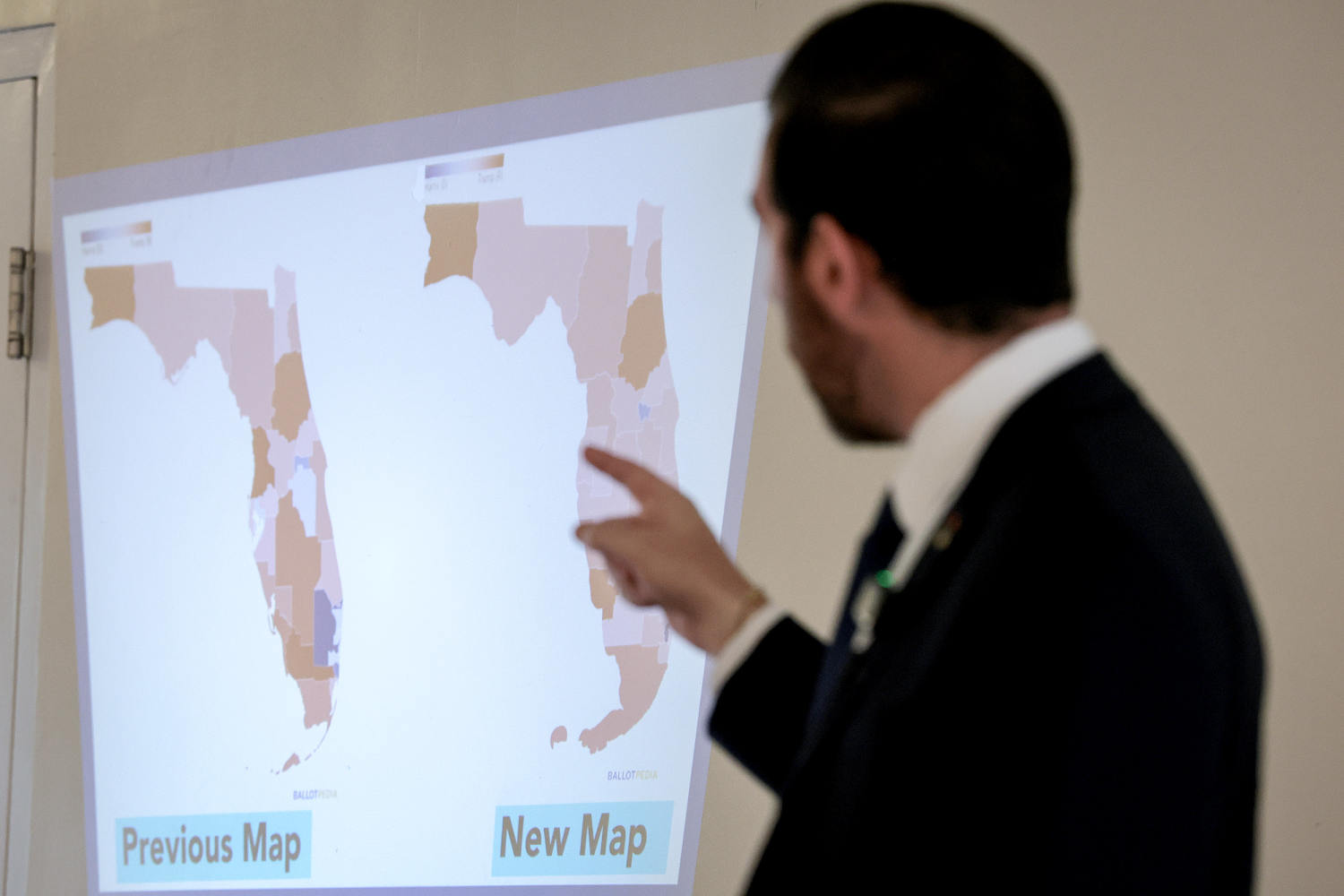
TALLAHASSEE, Fla. – A significant legal showdown has officially begun in Florida, as attorneys for Governor Ron DeSantis’s administration squared off against advocacy groups seeking to block a newly drawn congressional map. This isn't just a local skirmish; it's a pivotal moment in the national debate over partisan gerrymandering, with implications for electoral fairness and the very interpretation of voter-approved constitutional safeguards across the United States. At stake are four potentially new GOP-leaning congressional seats and the integrity of Florida's 'Fair Districts' amendments, passed by a resounding 63% of voters in 2010.
The central contention revolves around whether DeSantis’s map-drawer, Jason Pereda, utilized political data in crafting the new districts, a practice explicitly prohibited by the Fair Districts amendments. Plaintiffs argue that Pereda's own testimony last month, where he conceded using partisan data, constitutes a clear violation. “This case is unusual because the map-drawer admitted on the public record that the districts were drawn with partisan data and without the need to comply with the Fair Districts amendments,” asserted Christina Ford, an attorney representing Equal Ground, one of the three advocacy groups suing to halt the map’s implementation.
The Heart of the Dispute: Fair Districts vs. Federal Law
Governor DeSantis and his legal team counter that the Fair Districts amendments, particularly their provisions designed to protect minority groups’ ability to elect candidates of choice, are now at odds with federal law. They point to a recent U.S. Supreme Court decision that significantly limited the use of race in redistricting, arguing this decision effectively renders parts of the Fair Districts amendments obsolete or unenforceable. This argument forms the bedrock of DeSantis’s broader strategy: to potentially elevate this issue to the Florida Supreme Court, hoping the justices will overturn or significantly reinterpret the Fair Districts provisions.
During a robust, two-hour hearing before Tallahassee Judge Joshua Hawkes, attorneys for DeSantis, Florida Secretary of State Cord Byrd, and the Florida Legislature pushed back against the plaintiffs’ request for a temporary injunction. They contended that such an injunction should not be granted without a full trial and that the newly passed maps should be used in the upcoming 2026 midterm elections. Mohammad Jazil, representing both Byrd and DeSantis, argued that the plaintiffs were selectively quoting Pereda’s testimony. “Pereda was up there for hours explaining in painstaking detail how he drew the map,” Jazil stated, suggesting that focusing solely on Pereda’s admission of “partisan awareness” was taking his comments out of context.
Expert Analysis: Implications for American Democracy
Legal experts across the nation are watching this case closely. Dr. Michael McDonald, a political science professor and redistricting expert at the University of Florida, notes that this case highlights a growing tension between state-level anti-gerrymandering reforms and federal court interpretations. “The DeSantis administration is clearly trying to push the envelope, seeing if they can dismantle voter-approved protections under the guise of complying with federal law,” McDonald explains. “If successful, it could set a dangerous precedent, undermining the will of voters who sought to curb partisan manipulation of electoral maps.”
The implications for Americans, particularly those living in Florida, are profound. Gerrymandering can dilute the power of individual votes, create safe seats for incumbents, and reduce accountability, leading to more polarized political landscapes. Simone Leeper, an attorney for the Campaign Legal Center, another group challenging the maps, underscored this concern: “Any level of improper partisan intent is too much.” This sentiment resonates with a significant portion of the American public who believe that voters, not politicians, should choose their representatives.
A National Trend of Mid-Decade Redistricting
Florida’s legal battle isn't an isolated incident. It’s part of a broader, national mid-decade redistricting effort, initiated by the White House last year, which began with Texas Republicans. This strategy aims to capitalize on existing political majorities to further solidify Republican control in the U.S. House of Representatives. By redrawing maps outside of the decennial census cycle, states can potentially create more favorable electoral conditions for the dominant party, often sparking legal challenges and intense partisan wrangling.
Judge Hawkes concluded the hearing without an immediate ruling, stating he would issue a written order on the request for a temporary injunction. This decision, whenever it comes, will undoubtedly be scrutinized by both sides and could pave the way for an even more protracted legal fight. The outcome will not only determine Florida’s congressional map for the 2026 midterms but could also significantly influence the ongoing national debate over gerrymandering, voter rights, and the delicate balance between state constitutional provisions and federal judicial interpretations.
As this high-stakes legal drama unfolds, the focus remains on ensuring that the voices of Floridians, as expressed through their vote for Fair Districts, are upheld, and that the principles of representative democracy are not undermined by partisan maneuvering. The nation will be watching closely to see whether the Sunshine State's courts will affirm the power of the people or allow for a redraw that could fundamentally alter its political future.

💬 Comments (0)
No comments yet. Be the first to share your thoughts!
Leave a Comment