
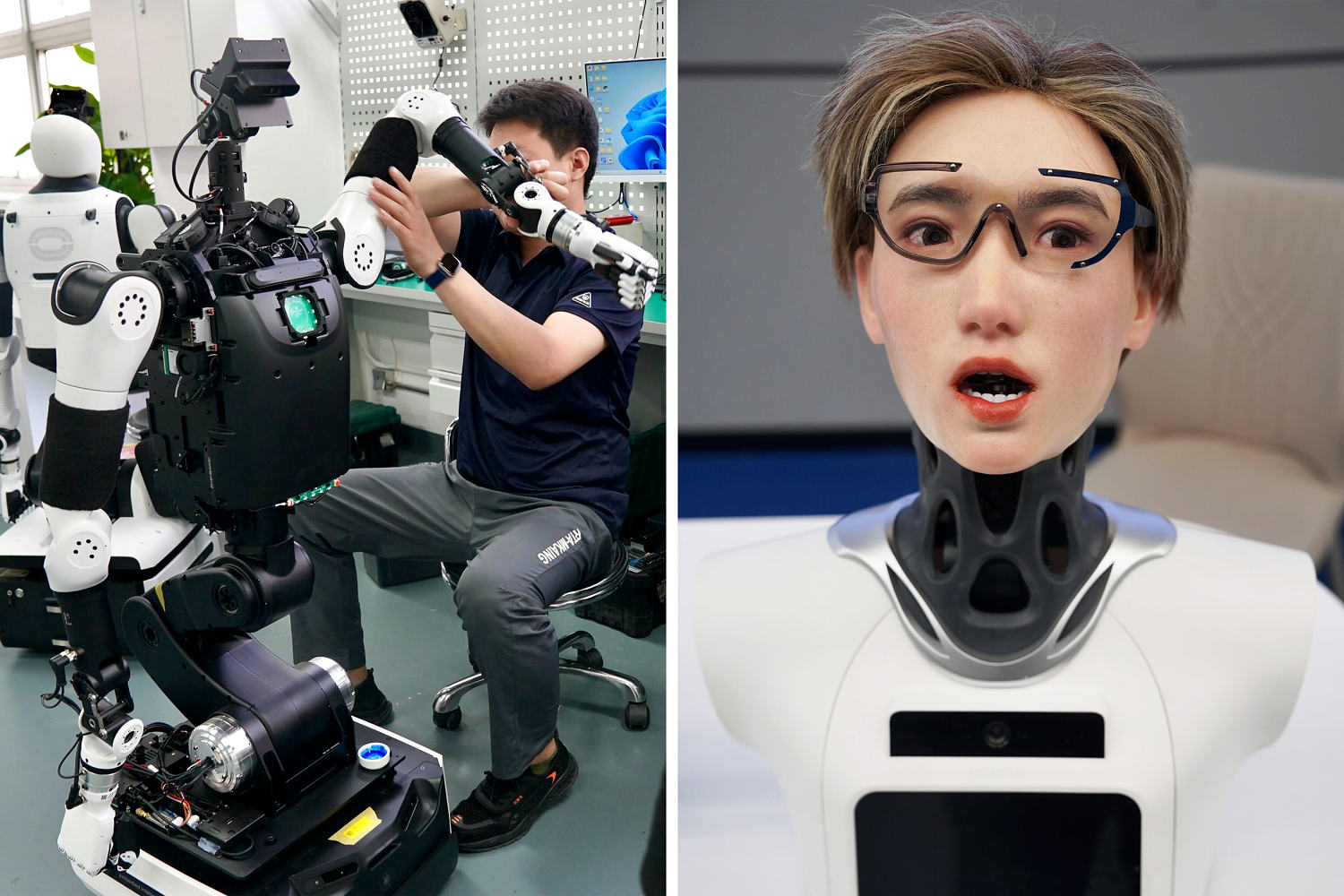
Beijing is buzzing with the whir of motors and the gleam of polished metal, as China accelerates its bid to dominate the burgeoning humanoid robotics industry. Once seen as clumsy curiosities, these machines are rapidly evolving, shedding their exposed wires and plastic shells for more sophisticated designs that aim to blur the lines between human and machine. For Americans, this isn't just a distant tech story; it's a front-row seat to a pivotal technological race with profound implications for our future.
NBC News recently gained exclusive access to X-Humanoid in Beijing, a company at the forefront of this revolution. Their facility showcased a bionic face prototype, complete with artificial skin and hair, a stark departure from the utilitarian robots of yesterday. Nikita Gao, who handles X-Humanoid’s overseas market, articulated the driving philosophy: “If the robots look more like humans, they can do a lot of stuff that humans can do.” This vision underscores China's strategic push into advanced robotics, a key battleground in the intensifying tech rivalry between the United States and China, particularly in artificial intelligence.
Beijing has placed robotics at the absolute center of its national agenda. Its latest five-year plan explicitly targets “the frontiers of science and technology,” with humanoid robots playing a crucial role. One stated goal is to leverage these machines to address China's rapidly aging population, a demographic challenge that mirrors trends in many developed nations, including the U.S.
China's Rapid Robotics Ascendancy
The progress has been nothing short of breathtaking. Consider the Beijing marathon for robots. Just last year, the event was a comical spectacle, with only a handful of robots stumbling across the finish line. This year? Over a hundred robots competed, and the winner blazed through the 13-mile course in just over 50 minutes. That's seven minutes faster than the human world record for a half-marathon, set by Ugandan long-distance runner Jacob Kiplimo. While it's crucial to note the specific conditions and potential optimizations for robots in such a race, the sheer leap in performance is undeniable.
Public displays also highlight China’s growing prowess. The recent Lunar New Year gala on Chinese state broadcaster CCTV featured robots executing intricate somersaults and synchronized martial arts movements, a stark contrast to the less sophisticated performances of previous years. Beyond agility, scale is also being redefined. Unitree Robotics, a Chinese company, recently unveiled a nearly nine-foot-tall humanoid robot with a cockpit capable of carrying a human inside. Dubbed the GD01, this 1,100-pound behemoth can transition between bipedal and quadrupedal locomotion, offering a glimpse into the “mecha” machines long fantasized in science fiction. Priced at $650,000, Unitree claims it's the first of its kind, and even Elon Musk, whose company Tesla is also developing humanoid robots, has reportedly called the Chinese bots “cool.”
The Brains of the Bots: A Critical Frontier
Despite these impressive strides, a critical frontier remains: the “brains” of these robots. Joanna Stern, NBC News’ chief technology reporter, correctly points out, “Where all of the robotics industry needs to improve is in the brains of these robots, in the software that allows these robots to actually do the things we want, whether they be in a house or an industrial setting.” This points to the core challenge of artificial intelligence and machine learning – developing truly autonomous and adaptable systems that can navigate complex, unpredictable environments without constant human oversight.
For American innovators and policymakers, this is both a wake-up call and a strategic opportunity. While China’s hardware advancements are undeniable, the U.S. has historically held an edge in foundational AI research, software development, and ethical frameworks for emerging technologies. Maintaining and extending this lead is paramount. Investment in STEM education, advanced research and development, and fostering an ecosystem that encourages innovation will be crucial for the U.S. to compete effectively.
Implications for Americans
The implications of China’s push for humanoid robotics dominance are multifaceted for Americans. Economically, a surge in highly capable, low-cost humanoid robots could impact manufacturing, logistics, and even service industries. American businesses need to prepare for a future where robotic labor becomes increasingly commonplace, requiring strategies for workforce retraining and the creation of new, robot-adjacent jobs. The race also has national security implications, as advanced robotics can be dual-use technologies, applicable in both civilian and military contexts. Ethical considerations, such as the deployment of autonomous systems and data privacy, also become more pressing as robots become more human-like and integrated into daily life.
As China continues to pour resources into making its robots not just functional but also relatable, the global robotics landscape is poised for a dramatic transformation. The exposed plastic and aluminum are giving way to artificial skin and hair, and the stumbling gait to record-breaking speed. For Americans, the question isn't whether this future is coming, but how we will shape our own role in it, ensuring that our innovation, values, and economic interests are protected and advanced in this exciting, yet challenging, new era of intelligent machines.




💬 Comments (0)
No comments yet. Be the first to share your thoughts!
Leave a Comment